
Facing criminal charges doesn’t mean facing them alone. Pazuki Law Group offers free, confidential consultations so you can understand exactly what you’re dealing with and what your options are—before making any decisions.
When someone is arrested and held for a bail hearing, the hours before that hearing matter more than almost anything that follows. The release plan, the surety and the conditions put forward often decide whether a person goes home or stays in custody while the case goes on. That is the time to speak with a bail hearing lawyer.
Pazuki Law Group represents people at bail hearings, bail variations and bail reviews throughout Newmarket, Aurora, Richmond Hill, Vaughan, Markham, Bradford, Barrie and communities across York Region and Simcoe County, and we can assist at weekend and holiday bail court when it is needed. Many of the calls we receive about bail come from family members acting quickly, often late at night, so this page is written for them as much as for the person in custody.
Police can release a person with a court date and conditions, or hold them for a bail hearing. If they are held, they must generally be brought before a justice within 24 hours where one is available. Ontario holds bail court every day of the year, including weekends and holidays, and many hearings now take place by video.
The person in custody has the right to speak with a lawyer without delay. Phone calls from jail are generally recorded, so nobody should talk about the allegation on those calls.
In most cases the Crown has to show why the person should stay in custody. In some situations that is reversed, and the accused has to show why they should be released. This is called a reverse onus. It applies, for example, to people charged while already on release for another offence, and to certain serious or repeat allegations. Changes to the Criminal Code in July 2026 added more reverse onus situations, and courts now look especially closely at the release plan in those cases. If a reverse onus applies, the plan has to be stronger from the start.
A bail court looks at three questions:
In most cases the law starts from release on the least restrictive terms that answer those concerns. Since July 2026, that step-by-step approach no longer applies where the accused carries a reverse onus. Either way, a realistic plan is what gives the court a reason to say yes.
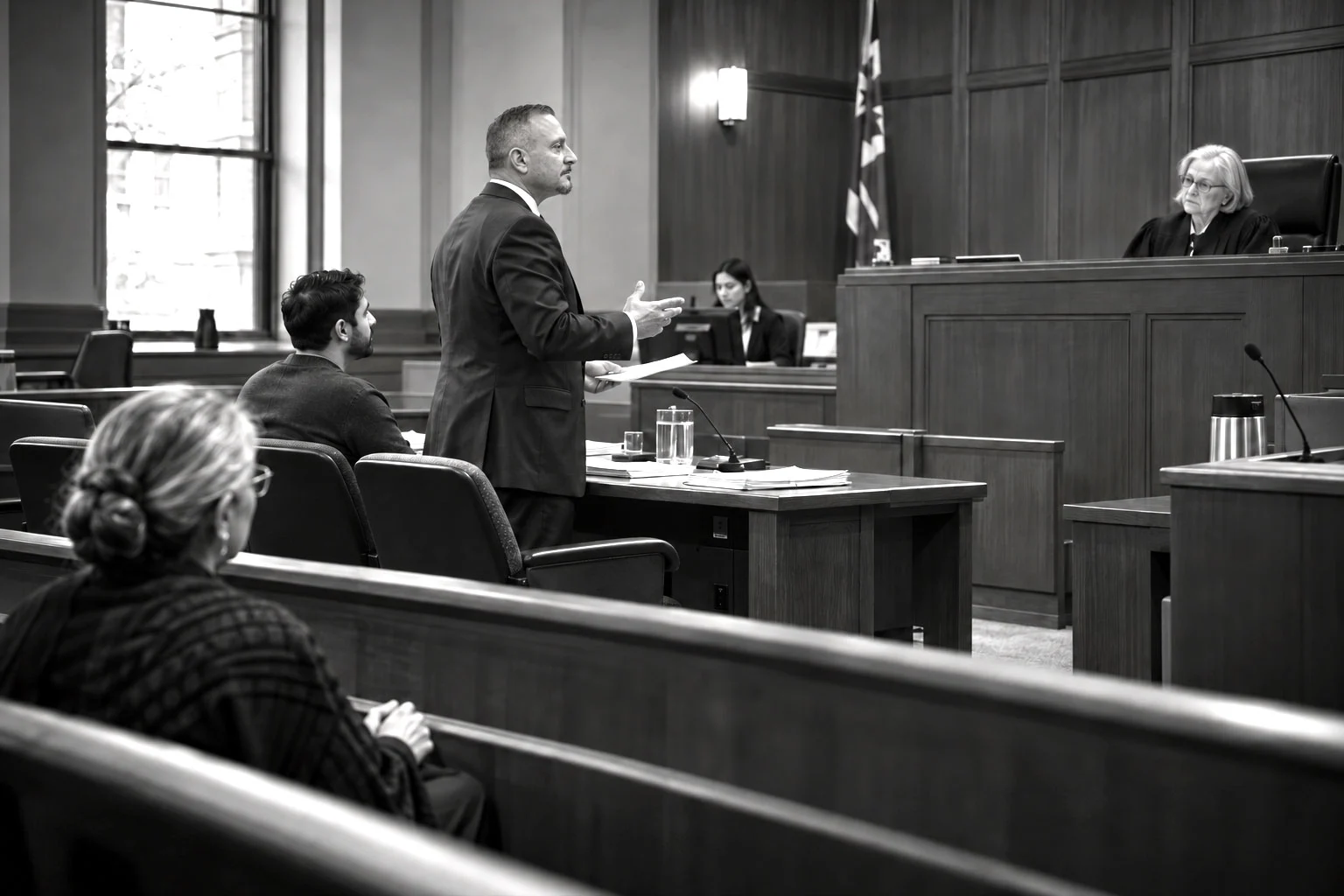
Bail hearings for charges laid in Newmarket and most of York Region are heard at the Newmarket courthouse at 50 Eagle Street West.
Simcoe County matters are heard in Barrie, Bradford, Orillia, Collingwood or Midland, depending on where the charge was laid.
We appear at bail court across Ontario, in person or by video where the court allows it.
Bail is often the first step in a larger case. Once the person is home, we can carry on with the defence of the charge itself, whether it is assault, impaired driving or another criminal charge.
A release plan is a proposal to the court: where the person will live, who will supervise them, and what limits will apply. Conditions can include a curfew or house arrest, no contact with named people, staying away from certain places, surrendering a passport, not having weapons, or attending counselling.
Conditions have to be workable. Terms that cannot realistically be kept lead to breach charges, and those make everything harder. Part of our job is proposing conditions that answer the court’s concerns without setting someone up to fail.
The sooner we start, the stronger the release plan. Talk to us about the hearing, the surety and the next steps.
Someone in custody right now? Call our 24/7 emergency line: 647-284-2824.
A person must generally be brought before a justice within 24 hours where one is available. The hearing itself is sometimes put over for a short time, often so a surety can attend or a plan can be completed.
Usually not up front. A surety pledges an amount and can lose it if the conditions are broken. Ontario's new rule requiring the pledged amount to be deposited in cash was suspended by the court on 31 August 2026 while a constitutional challenge proceeds. Cash deposits can still be ordered in limited situations under the Criminal Code.
Possibly. Since July 2026, someone convicted of a serious offence in the past 10 years generally cannot be named as a surety unless no other suitable surety is available. Older or less serious records are a factor the court weighs. Tell the lawyer about any record before the hearing, not in the witness box.
It can lead to a new charge, an arrest and a much harder time getting released again. The surety can also lose the money they pledged. If a condition cannot be kept, the answer is to apply to change it, not to ignore it.
Yes. If the Crown and the sureties agree, a variation can often be arranged quickly. If not, an application can be made to the court. Until the order is changed, the existing conditions apply.
In most cases the detention order can be reviewed by the Superior Court, especially where there is a new or better plan, a new surety or new information. Have a lawyer look at the transcript and the reasons for the decision.
A surety is a person, usually a family member or close friend, who agrees to take responsibility for someone released on bail. Not everyone has a family member or friend who can act as a surety. Ontario’s bail program, the Bail Verification and Supervision Program, is designed for people who have no available surety. Program staff assess the person and, if they accept them, supervise them in the community while the case goes on. We work with the program and with the family to put together a bail plan the court can accept. Without a suitable plan, release is very hard to get.
Circumstances change. A new job, a move, childcare or a condition that turned out to be unworkable can all justify a change. If the Crown and the sureties agree, a variation can usually be arranged without a contested hearing. If they do not agree, the change can be sought in court.
Do not treat a condition as flexible in the meantime. It applies until it is formally changed, and breaking it is a separate criminal offence.
A refusal of bail is not always the end of it. In most cases a detention order can be reviewed by a judge of the Superior Court of Justice. A review can succeed where there is new information, a stronger plan, a different surety, or an error in the first decision. The transcript of the original hearing and the reasons for the decision are the starting point.
Every legal matter is different. Share a few details about your situation, and our team will contact you to discuss your case, your options, and the next steps.